• The Holy Pavarana is an important day of Theravada Buddhist World and Celebrated on the full moon of the Eleventh lunar month. It marks the end of the month of Vassa” or Buddhist Lent." Literally ‘pavarana’ means inviting admonition and Purnima means the 'Full Moon Day'. This day marks the end of the Rainy Season in Asian countries and abroad wherever they follow Theravada Buddhist Tradition.

  • Hollywood star Angelina Jolie, who is set to marry fiance Brad Pitt this summer, has picked her wedding date with the help of a Buddhist monk.

  • Are there no law and order in Bangladesh while 25 thousand Islamists demolished Buddhist temples, houses and business centres dated September 29, 2012?

  • Pala dynasty, which brought prosperity and stable government to the region for more than four centuries. Its patronage nurtured the arts and sheltered the remnants of the of the Buddhists in the Indian subcontinent where Hinduism was becoming a powerful force. The Palas were the last powerful Buddhist Monarchs on the subcontinent.They also established diplomatic relations with kingdom of Srivijaya,which controlled much of the Indonesian archipelago.

  • Buddhism strongly claims that World peace is achievable when there is no longer conflict over resources. Till now different people have given different types of theoretical possibility for the world peace

  • Bangladesh has successfully separated the Judiciary from the Executive but several black laws still influence the rulers in creating Special Tribunals in using several black laws including the Special Powers Act.

  • TREAT EVERYONE WITH POLITENESS, EVEN THOSE WHO ARE RUDE TO YOU, NOT BECAUSE THEY ARE NICE BUT YOU ARE.

Next
Previous
Showing posts with label Basket of Discipline.. Show all posts

Thursday, October 17, 2013

Pavarana Purnima (Pavarana Puja)

Posted in , , , ,
Pavarana Purnima
Pavarana Purnima in Bangladesh
Wishing Everyone a Peaceful and Prosperous “Happy Pavarana Purnima and Fanush Festival 2013”

Pavarana Purnima

The Holy Pavarana is an important day of Theravada Buddhist World and Celebrated on the full moon of the Eleventh lunar month. It marks the end of the month of Vassa” or Buddhist Lent." Literally ‘pavarana’ means inviting admonition and Purnima means the 'Full Moon Day'. This day marks the end of the Rainy Season in Asian countries and abroad wherever they follow Theravada Buddhist Tradition.

   Pavarana Purnima In USA

Pavarana Purnima in Bangladesh

Pavaraba Purnima in Bangladesh
On this auspicious day, Bangladeshi Buddhists, After commemorating this auspicious day, with Precepts and meditation and Buddhist traditional rituals and other Buddhist important functions will fly thousands of Lanterns in the evening. This is one of the most popular festival among Barua Buddhists in Bangladesh. Due to this popularity, Pavarana Purnima is also known as Fhanush Festival. 
On this day, Buddhists wake up early in the morning and after taking a goes to the temple to receive Five Precepts and Eight

Thursday, September 26, 2013

Conversion of Yasa and 54 friends

Posted in , , , , , , , , , , ,


Conversion 

Monks reading and checking things that have been destroyed

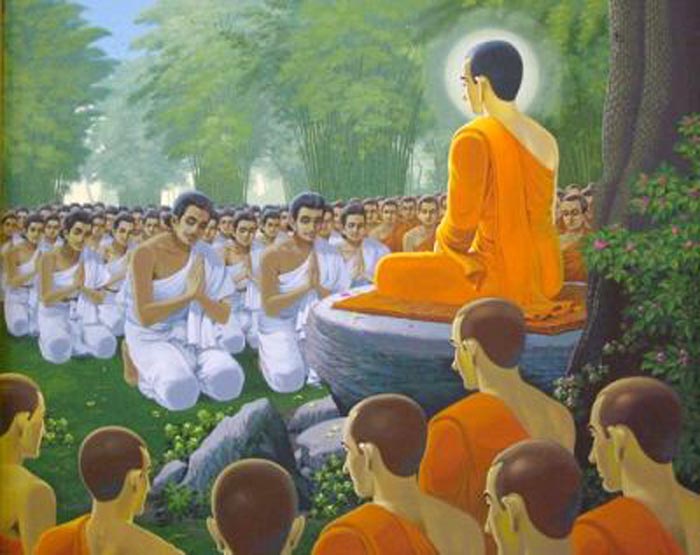
At Benares, there was a millionaire’s son named Yasa who had abundant material wealth. One night, he fell asleep during a musical performance by his female dancers and musicians. He woke up in the early hours of the morning to the sight of his sleeping performers in unbecoming postures. The entire scene before him was one that resembled that in a cemetery. He left home feeling distressed and oppressed and walked in the direction of Isipatana, where Buddha was residing. When Yasa moaned his distress upon seeing the Buddha, He assured Yasa that there was neither distress nor oppression there.

8 Kinds of Ordination

Posted in , , , , , , , , , ,


  1.  ‘Ehi Bhikkhu……’    ‘Come, O monks….’

Ehi Bhikkhu upasampada, Monks going for Pindapatha
Monks going to Als-Round
This was the first kind of ordination. After listening to the discourse, any matured person who was convinced of the Dhamma, could be ordained by the Buddha in this manner. Buddha stretched his right palm and say Ehi Bhikkhu and the man would be accepted into the order. He would don his robe and shaved his head. This ordination became higher ordination at the same time. Today the tradition is different as both ordination and higher ordination are on 2 occasions. (Pabbajjan is ordination, i.e. entrance to the order. Upasampada is higher ordination.) 


Tihi Sarana gamana pabbajja

Tihi Sarana gamana pabbajja
Initially, only Buddha could ordain monks. This became time and energy consuming. Buddha then said to his monks “O monks, I advise you to give ordination and higher ordination wherever you are. Today, I’m going to share with you the ordination process. From today onwards, you will be able to ordain others.” Ordination process introduced by Buddha: - where the monks take refuge in Buddha, Dhamma and Sangha.

Friday, April 27, 2012

0

My experiences from meditation retreat in Buddhamonthon 2009.

Posted in , , , , , , , , , , ,

Introduction
On 17th December I went to Buddhamonthon for ten days meditation retreat organized by the University Mahachulalongkornrajavidyalaya. 17th was the first day so everyone was little busy with tend preparation and the opening ceremony. Then on 18th was the second day and we all were busy meditating. There were three meditation teachers to show how to meditate in the proper ways, not only that there were three security gards as well, their names are as follows: Phra maha Doung dee, Phra maha Suriyo and Sridee. They were the monks to control the students up there. At first I was unable to sit still with all the problems that I faced up there but I sat still calmly. Because some of us were warned that we have to go back if we don’t change our tends immediately. So whenever we go to meditate we saw a monk checking our tends. So due this I was frightened that i will be suspended from there. Slowly slowly I made up my mind to try to meditate properly so that I can get rid of the fear.
0

Self control

Posted in , , , , , , , , ,

Introduction

            We have all disappointed ourselves through being uncontrolled mind at some time. There are many times in our life when we have to do, to go, to act. Self Control is not always staying still, not hurrying, not rushing. Everything has to be ready on time, and Self Control is the discipline and training to be able to achieve our objectives.

            Self Control brings beauty. Self Control brings strength. Self Control brings happiness.  Through Self Control we can achieve our goals.

Tuesday, April 24, 2012

0

Please explain in details what is the Vinaya Tipitaka?

Posted in , , , , , ,

The Compilation of Discipline, which contains the rules laid down for the guidance of the monks and nuns and the regulations prescribed for the harmonious functioning of the monastic order. Basket of (monastic) Discipline - The rules governing the conducts of bhikkhu and bhikkhuni. The regulations pertaining to internal affairs of the Sangha or the monastic order. It is made up into five books.
1.     Pārājika Pāli      
2.     Pācittiya Pāli
3.     Mahāvagga Pāli
4.     Cūl,avagga Pāli
5.     Parivāra Pāli
 Pārājika Pāli and Pācittiya Pāli is suttavibhanga, Mahavagga pali and Culavagga are khnadaka.

•     Suttavibhanga
•      227 and 311 rules for monks nuns (Vin III, IV) Pārājika: ‘Defeat’ – rules entailing expulsion from the Sangha four for bhikkhus and eight for bhikkhunis.
•     Sanghādisesa: a set of rules which require formal participation of the Sangha from beginning to end in the process of making him/her free from the guilt of the offence. Thirteen for bhikkus and seventeen for bhikkunis.
•     Aniyata: indefinite rules two for bhikkus.
•     Nissaggiya pācittiya: rules entailing forfeiture and confession. Thirty for both bhikkus and bhikkunis.
•     Pācittiya: rules entailing confession. Ninty two for bhikkus and hundred sixty six for bhikkunis)
•     Pāt,idesanīya: rules entailing acknowledgement. Four for bhikkus and eight for bhikkunis.
•    Sekhiya: rules of training. Seven five for both bhikkus and bhikkunis.
•     Adhikaran,asamathādhammā: rules for settling disputes. seven for both bhikkus and bhikkunis.